
Primary HVM chassis
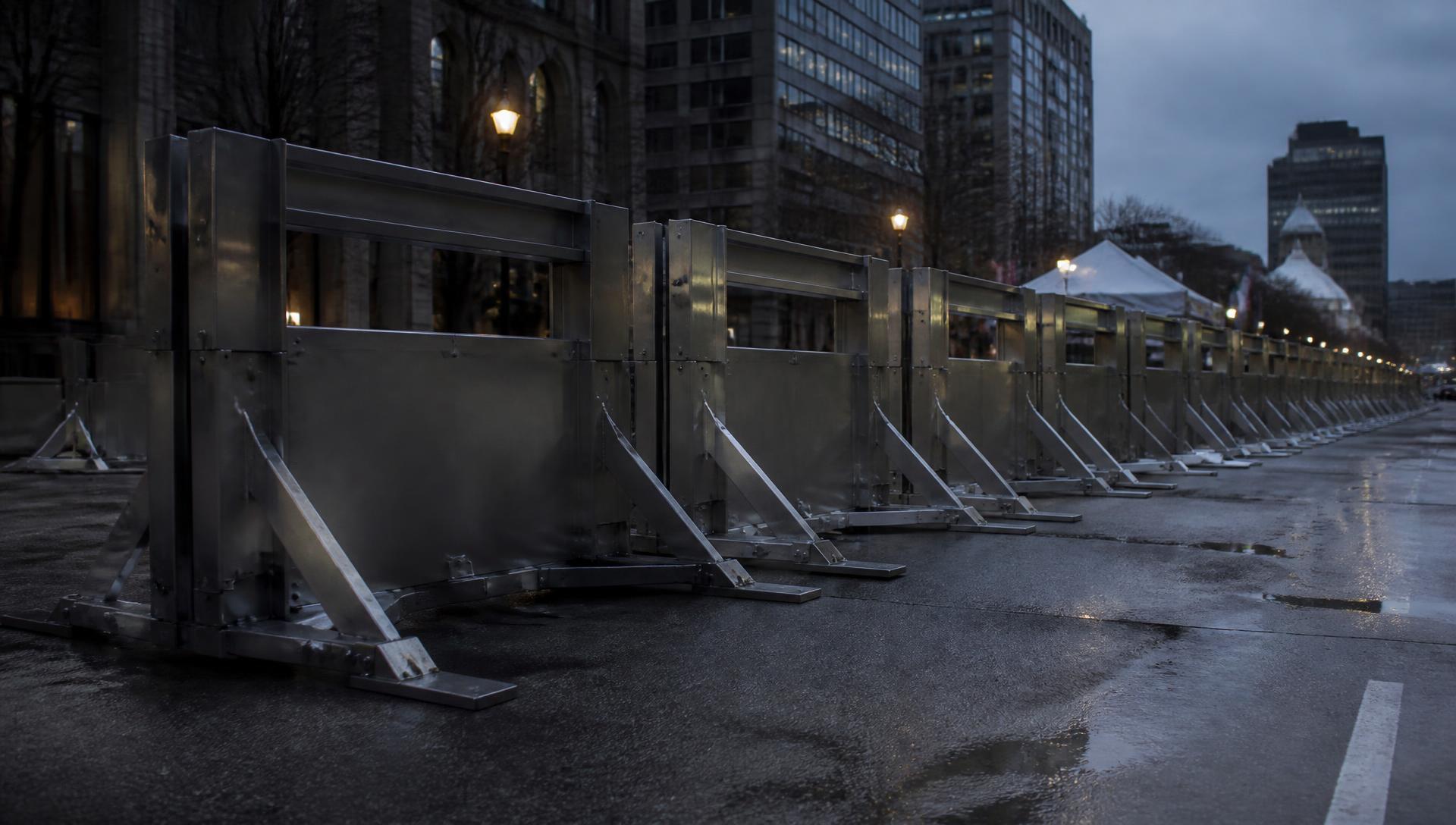
A substantial fabricated steel structure with ground-engaging legs and an upright protective frame. Wheel-free once deployed, with optional ballast and optional ground anchoring where site conditions permit.
Hostile vehicle mitigation
CastleWall is a modular vehicle security system engineered around rapid deployment, public access and verified protective-security assurance: a surface-mounted HVM chassis, a common connection architecture, interchangeable protection cartridges, access modules and the transport and handling platform that moves them.
Rather than a single fixed product, CastleWall is an architecture. The primary chassis stays the same while the protective function, perimeter geometry and access arrangement change to suit the site.
A substantial fabricated steel structure with ground-engaging legs and an upright protective frame. Wheel-free once deployed, with optional ballast and optional ground anchoring where site conditions permit.
Barriers, screening panels and access units join through a common releasable connection system, so straight runs, corners, junctions and enclosed zones are built from the same parts.
The centre section between the upright posts accepts different functional cartridges, so one chassis can be reconfigured on site without structural alteration.
Positioned using a purpose-designed trolley, then set down wheel-free. Built for events, public spaces, councils and venues needing temporary or semi-permanent protective security.
One platform, six configurations
Permanent lines, temporary runs, event perimeters and public-realm treatments are all built from the same connection architecture — including the handling and transport equipment that moves hundreds of units in a working day.
Fixed perimeter lines for venues, precincts and estates where a standing stand-off zone is required year round.
Rapidly deployable runs for seasonal, project and short-notice requirements — installed, recovered, stored and redeployed.
Controlled event perimeters for festivals, markets, fan zones, shows and city-centre events with defined entry points.
Perimeter protection that reads as public realm — screening, seating-scale forms, planting and signage rather than overt counter-terrorism hardware.
Pedestrian, accessible, service and emergency-vehicle openings engineered into the same connected line.
Trolleys, lifting and forklift interfaces, stacking and transport frames — the handling platform designed alongside the barrier, not after it.
CastleWall manages impact through mass, ground engagement and a connected perimeter. The sequence below describes the intended behaviour of the design; it will be confirmed by the independent test programme.
Hostile vehicle engages the primary chassis face.
Ground-engaging legs and unit mass resist initial displacement.
Energy is managed through the frame and, where fitted, ballast and anchoring.
Discrete links between neighbouring units help distribute load along the perimeter.
The connected perimeter resists separation and brings the vehicle to rest.
One chassis, many roles
Cartridges fit a common mechanical interface between the two upright posts, so the secondary protective function can be changed without dismantling or modifying the vehicle-resistant chassis.
Standard infill for a continuous visual and physical screen.
Event wayfinding, sponsor artwork and public information carried by the perimeter itself.
Steel, composite or transparent ballistic material where a raised protective requirement is identified.
Intended to provide limited interception of low-level small drones and thrown objects.
Camera, lighting and beacon modules mounted through the same common interface.
Alarm and communications equipment carried in place of a passive panel.
Access units connect into the same perimeter and the same load-transfer architecture, so a gateway is not a weak point in the line.
Removable upright poles locate into apertures in the top of the barrier and bolt to the structure. Netting is tensioned between poles and can continue across several interconnected barriers.
A removable or integrated security unit gives an operator visibility of the deployed perimeter, not just the individual barrier.
Tilt and vibration sensing
Audible alarm and visual beacon
SIM-enabled remote alerts
GPS location and geofencing
Tamper monitoring
Networked standalone alarm nodes
Deployment assurance records
Recognition of the installed cartridge
The Terrorism (Protection of Premises) Act 2025 received Royal Assent in April 2025. Its substantive duties are not yet in force; commencement is expected in 2027, which makes the period now a specification and planning window rather than a scramble.
Standard-tier premises (200–799 people expected) focus on procedures — evacuation, invacuation, lockdown and communication. There is no blanket requirement for those premises to buy physical security equipment, and we do not pretend otherwise.
Enhanced-tier premises and qualifying events (800+) must additionally put in place measures that reduce vulnerability. Home Office statutory guidance expressly lists hostile vehicle mitigation, vehicle security barriers, bollards, street furniture, fences, walls, gates, blockers, bunds, berms and planters among the physical measures a responsible person may consider.
Measures are weighed against vulnerability, effectiveness, cost, time and difficulty. Proportionate, modular protection is often the defensible answer where a major civil-engineering scheme is not.
The responsible person is whoever controls the premises or event — often the operator or organiser rather than the landowner — and enhanced sites must nominate a senior individual. We are used to working across security, estates, facilities, event operations and board-level stakeholders.
No barrier is “Martyn's Law approved” or “Martyn's Law compliant”; organisations comply, products support compliance. CastleWall is intended as an impact-tested vehicle security barrier designed to support appropriate hostile vehicle mitigation measures under the Act. Nothing here is endorsed by the Home Office or the SIA, and nothing here is legal advice.
Hostile vehicle mitigation is a system, not a heavy object. Impact energy rises with the square of approach speed, so a barrier is only meaningful against a defined threat vehicle, speed, angle and permitted penetration. We start with the operational requirement and work toward vehicle-impact testing under ISO 22343-1:2023, the current standard for vehicle security barriers, alongside the established IWA 14-1 and PAS 68 references and the NPSA Vehicle Attack Delay Standard, which addresses repeated hostile attack rather than a single impact. Simulation informs the design; it does not replace an accredited impact test.
The question that matters in a crowded space is not simply whether a vehicle is stopped, but how far past the barrier line it travels before it stops. Penetration is treated as a headline design objective, not a footnote in a certificate. Where the site allows, approach geometry and traffic management are used to reduce achievable attack speed before a vehicle ever reaches the line.
These are the engineering objectives the system is being developed against. They are targets, not achieved ratings — no certified performance is claimed until testing is complete.
Enhanced-tier operators must document the measures in place and how they reduce vulnerability, keep that document current and provide it to the regulator. A barrier delivered without paperwork leaves the customer to write it themselves, so CastleWall is designed to be supplied with the engineering evidence behind it.
For temporary protection, the hard problem is rarely the steel. It is moving, positioning, verifying, recovering and storing hundreds of modules to a schedule, with limited crew and limited road closure time. CastleWall is engineered as one platform: the protection system and the handling system designed together.
Modules travel substantially assembled on integral wheels and lock into their operating position without loose parts or separate tooling.
A dedicated deployment stillage where each module has a numbered home that maps directly to a zone on the site drawing — unload, position, lock, scan.
Connections are designed so that an incorrect or incomplete deployment is difficult to achieve and easy to spot.
A dedicated module opens quickly for ambulance, fire, police and authorised vehicles without breaking the protected line elsewhere.
A perimeter is only as good as the way it was actually installed on the day. Each module carries its own identity, so a deployment produces a verifiable record rather than an assumption — the kind of evidence an enhanced-tier responsible person needs when documenting protective measures.
A perimeter also does not have to be a solid wall. What matters is preventing the vehicle envelope passing through, so pedestrian permeability, accessible routes, sightlines and crowd flow are designed in rather than traded away.
For local authorities, stadiums and security contractors holding their own protective-security assets.
For festivals, markets and short-duration venues needing protection for days or weeks, not years.
Survey, specification, delivery, installation, management and recovery handled as one engineered service.
Not every premises needs a barrier. We focus on sites and events with a real vehicle approach vulnerability, and on operators who redeploy protection repeatedly.
Stadiums, arenas, shopping centres, visitor attractions, hotels and conference centres, hospitals, universities and large public-authority premises with genuine vehicle approach vulnerability.
Festivals, Christmas markets, concerts, fan zones, race meetings, agricultural shows, exhibitions and major public celebrations operating a controlled perimeter.
Local authorities, business improvement districts, pedestrian zones, transport interchanges, stadium precincts and town-centre regeneration schemes.
Prototype equipment exists and the system continues in active development.
Independent vehicle-impact testing and other relevant testing are planned for the configurations that are commercialised.
Higher vehicle-class capability is a design and test target. No certified performance rating is claimed until testing is complete.
CastleWall is described here as a system in development. Protective functions such as drone and thrown-object netting are described as providing limited interception, and are not presented as certified counter-drone protection.
For event organisers, councils, venues and security consultants reviewing CastleWall for an upcoming perimeter requirement, or to discuss manufacturing and supply.